 StudyDesk

Eleven days left, and the form is not the problem
For most Central Sector schemes on the National Scholarship Portal, student applications for 2026–27 close on 31 October 2026. Institute verification then runs to 15 November, and district, state and ministry (Level-2) verification to 30 November. Those dates are not the real deadline problem. The real problem is that almost nobody loses an NSP scholarship at the "submit" button. They lose it earlier and quieter: an OTR that never gets generated because face authentication keeps failing, a name that does not match Aadhaar, a bank account that is not Aadhaar-seeded so the payment has nowhere to go, or an institute nodal officer who defects the application in mid-November when there is no time left to fix it.
This is a clinic, not a scheme list. It takes the failures in the order students actually meet them, from first login to final payment, and gives the fix for each.
Failure 1: the OTR will not generate
One Time Registration is mandatory before any application. The OTR is a unique 14-digit number, generated from your Aadhaar (or an Aadhaar Enrolment ID), and it stays with you for your entire academic career — you generate it once, not once a year. The flow is: register on scholarships.gov.in with your mobile number, receive a reference number, then complete face authentication in the NSP OTR mobile app together with the AadhaarFaceRD app. The OTR and a password are sent to your mobile.
When face authentication fails repeatedly, work through these in order:
- Light and framing first.Most failures are a badly lit face, a face off-centre in the frame, or a moving camera. Sit facing a window or a plain light, hold the phone at eye level, and keep still.
- Unlock your Aadhaar biometrics.If your biometrics are locked in the mAadhaar app or on the myAadhaar website, face authentication cannot complete. Set the biometric lock to Unlocked and retry.
- Update AadhaarFaceRD.Portal guidance as reported in NSP FAQ summaries links error 904 to an outdated AadhaarFaceRD app; update it from the Play Store and retry.
- No suitable phone? Use a Common Service Centre.A CSC can complete the process with proper scanning equipment. This is a legitimate route, not a workaround.
Two related OTR traps: if you registered with an Aadhaar Enrolment ID because you do not yet have an Aadhaar number, you must submit the Aadhaar within one month or the OTR can be suspended. And a minor without Aadhaar can generate the OTR using a parent's or guardian's Aadhaar — a guardian can generate OTRs for up to two minor children.
Failure 2: your details do not match Aadhaar
NSP pulls your identity from Aadhaar. If the name spelling or date of birth on your Class 10 marksheet, your institute records and your Aadhaar disagree, the mismatch surfaces at verification — usually at the institute, in November, when the officer defects the application back to you. Fix it now, in October, while correction is cheap: decide which document is wrong, correct it at the source (an Aadhaar centre for Aadhaar errors, the board for marksheet errors where that is even possible), and make sure the name you type into NSP is character-for-character the Aadhaar version. Do not "adjust" spellings inside the form to match a marksheet; the system validates against Aadhaar.
Failure 3: the bank account rejects the money
Even a fully verified application pays nothing if the bank account is not Aadhaar-seeded, because NSP scholarships are paid by Direct Benefit Transfer into the Aadhaar-seeded account. Seeding is not the same as linking your Aadhaar number at the branch for KYC; the account must appear in the NPCI mapper as your Aadhaar payment destination. If you hold several accounts, the DBT goes to the most recently seeded one — a classic cause of "the scholarship went to my old account". Check the seeding status, confirm which account is mapped, and track the eventual payment on the PFMS portal using your bank details or NSP application ID once both verification levels have cleared.
Failure 4: your institute defects the application in November
After you submit, your application sits with your Institute Nodal Officer until 15 November, then with Level-2 officers until 30 November. A defected application returns to you for correction and must be resubmitted and re-verified inside those same windows — there is no extension because your college was slow. Protect yourself three ways:
- Submit this week, not on 31 October. A form submitted on the last day that gets defected on 14 November leaves you one day of margin. A form submitted now leaves weeks.
- Meet your nodal officer before submitting. Institutes verify against their own records; a two-minute conversation about which bonafide certificate and fee receipt they expect prevents the commonest defects. If your institute is in a different state from your domicile, a bonafide certificate is specifically required.
- Assemble the standard document set before you start: bank passbook, educational documents, Aadhaar, domicile certificate and income certificate as your scheme's guidelines specify, caste certificate if applicable, and the bonafide certificate. Every scheme's own specification on NSP overrides any general list — read it.
Failure 5: you applied for the wrong combination of schemes
From 2026–27, NSP lets a student apply for one merit-based scheme and more than one welfare-based scheme, if eligible for each. Students who assume "one scholarship only" leave money unclaimed; students who apply to two merit-based schemes create a conflict the system will resolve against them. NSP marks each scheme as merit-based or welfare-based on the Schemes page, and the portal's eligibility checker shows the schemes your details qualify for — and, usefully, the reasons when you do not qualify for one. Run the checker before applying, not after.
A special case: applicants with disabilities must log in to the UDID portal and consent to sharing their UDID details before applying on NSP, or the portal blocks the application. Do the consent step first.
The eleven-day order of operations
- Today:generate or recover your OTR; fix face-auth failures with the steps above.
- Today:check Aadhaar biometric lock status and your bank account's Aadhaar seeding.
- This week:run the eligibility checker; pick one merit-based plus any welfare-based schemes you qualify for; read each scheme's specification.
- This week:collect documents; visit your institute nodal officer; then submit.
- Before 15 November:confirm your institute has verified (not just received) your application.
- Before 30 November:confirm Level-2 verification; afterwards, track payment on PFMS.
The NSP helpdesk is at [email protected] and 0120-6619540 (8 am to 8 pm, all days except government holidays). Use it for portal-side faults — an OTR stuck in a failed state is a helpdesk problem, not a reason to register a second time with a different mobile number, which only creates a duplicate identity to untangle later.
Sources & verification
Frequently asked questions
What is the last date for NSP applications in 2026-27?
For most Central Sector schemes, student applications for 2026–27 close on 31 October 2026. Institute verification then runs to 15 November, and district, state and ministry (Level-2) verification to 30 November.
What is the OTR and do I generate it every year?
One Time Registration is mandatory before any application. The OTR is a unique 14-digit number generated from your Aadhaar (or an Aadhaar Enrolment ID), and it stays with you for your entire academic career — you generate it once, not once a year.
Why does OTR face authentication keep failing?
Work through the fixes in this article in order: use good light and framing, unlock your Aadhaar biometrics if they are locked, and update the AadhaarFaceRD app, which portal guidance as reported in NSP FAQ summaries links to error 904. A Common Service Centre can also complete the process.
Why would a verified application still not be paid?
NSP scholarships are paid by Direct Benefit Transfer into the Aadhaar-seeded account, so an account that is not Aadhaar-seeded has nowhere for the payment to go. If you hold several accounts, the DBT goes to the most recently seeded one, and payment can be tracked on the PFMS portal once both verification levels have cleared.
How many NSP schemes can I apply for from 2026-27?
From 2026–27, NSP lets a student apply for one merit-based scheme and more than one welfare-based scheme, if eligible for each. NSP marks each scheme as merit-based or welfare-based on the Schemes page.
Who do I contact for a portal-side OTR fault?
The NSP helpdesk is at [email protected] and 0120-6619540 (8 am to 8 pm, all days except government holidays).
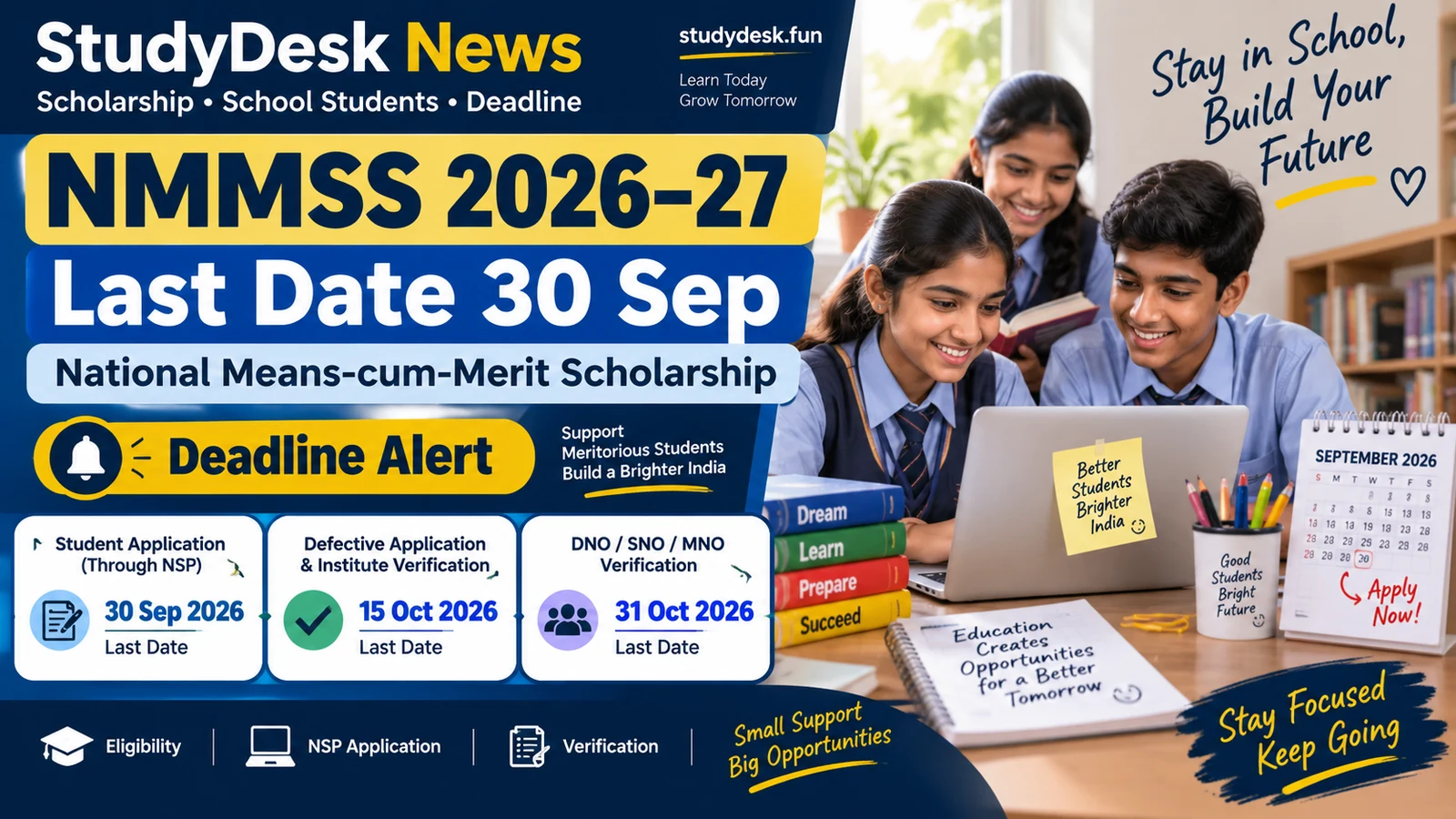
Deadline alert for National Means Cum Merit Scholarship 2026–27 applications on the National Scholarship Portal.

Complete guide to Siemens Scholarship Program 2026-27 (14th edition): eligibility, benefits for all four years, documents and how to apply on siemens.co.in/scholarship.
Complete guide to Winnie Sun Scholarship 2026-27: Lotus Petal Foundation support of up to Rs.65,000/year for girl students admitted to MBBS in FY 2026-27, eligibility, selection and how to apply.
Complete guide to Santoor Scholarship Program 2026-27 by Wipro Consumer Care and Wipro Cares: eligibility for first-year undergraduate girls in Andhra Pradesh and Maharashtra, Rs.30,000 one-time award, and how to apply via santoorscholarships.com.

Complete guide to Rajasthan SJE Scholarship 2026-27: Social Justice and Empowerment Department's post-matric schemes (PMS, CM Sarvjan, Dr Ambedkar EBC, SBC), eligibility, documents and how to apply on sje.rajasthan.gov.in.