 StudyDesk

Prelims was a filter. Mains is the merit list.
The IBPS Clerk (Customer Service Associate) prelims ran on 10 and 11 October 2026, and it is worth being precise about what it did: it decided who is allowed to compete. It did not decide who gets a bank. Clerk recruitment has no interview; the final merit is built from the mains examination alone, followed by document verification, the local-language proficiency requirement and provisional allotment. That means the paper on 27 December 2026 — four separately timed sections, 190 questions, 200 marks — is not the next hurdle in a series. It is effectively the whole competition, and the roughly ten weeks between the prelims and 27 December should be planned that way.
This guide assumes you appeared in the prelims and are preparing before the result, which is the correct assumption to make: candidates who wait for the prelims result to start mains preparation hand the serious competition a month's head start.
Where the marks actually sit
| Section | Questions | Marks | What it rewards |
|---|---|---|---|
| General / Financial Awareness | 50 | 50 | Months of accumulated current affairs — the least crammable section on the paper |
| General English | 40 | 40 | Reading speed and error spotting under time pressure |
| Reasoning Ability & Computer Aptitude | 50 | 60 | Puzzle stamina plus basic computer knowledge |
| Quantitative Aptitude | 50 | 50 | Data interpretation speed and arithmetic accuracy |
Two features of this table drive the whole plan. Reasoning and Computer Aptitude carries 60 marks — the heaviest section — and within it, seating and puzzle sets decide outcomes because they cluster marks: one solved set is worth four or five questions. And General/Financial Awareness cannot be manufactured in December. A candidate beginning GA in the final fortnight is competing against candidates who have banked banking-awareness and current-affairs notes since August. If your GA foundation is thin, the plan below front-loads it for exactly that reason.
Negative marking of 0.25 per wrong answer applies, as it did in the prelims — but the mains temptation is different: with sectional timing, the pressure is to attempt inside a closing window. Accuracy discipline matters more here than raw attempts.
The ten weeks, in three blocks
Weeks 1–3 (now to mid-November): rebuild at mains depth. Prelims preparation is shallower than mains preparation — shorter passages, simpler DI, lighter reasoning. Use this block to close the depth gap: full-length DI sets (tables, caselets, mixed graphs), multi-variable puzzles, mains-level reading comprehension, and the start of a daily GA routine — banking and financial news, RBI and SEBI developments, government schemes, reports and indices, appointments and awards. Write GA notes by hand or in a single running document; the act of summarising is the retention mechanism, and December revision will run off these notes.
Weeks 4–7 (mid-November to mid-December): sectional pressure. Shift to separately timed sectional tests, because the mains skill that fails candidates is not knowledge but section management — knowing within a section which questions to abandon. Sit at least two full mocks a week in this block, and keep an error log with three columns: concept errors (didn't know), selection errors (chose a time-sink), and execution errors (knew, but slipped). Each column has a different cure, and a single "silly mistakes" label cures none of them.
Weeks 8–10 (mid-December to 27 December): consolidation. Full mocks at the same time of day as the exam, GA revision from your own notes in repeated passes, and previous-year mains papers to calibrate difficulty expectations. The final week is for sleep discipline and document readiness, not for new topics.
Documents: the unglamorous section that ends candidatures
Shortlisted candidates move to document verification and provisional allotment on the strength of papers, and every year candidates lose allotments over documents they could have arranged in October. Keep ready: the application printout, prelims and mains call letters, a valid photo identity proof, photographs, Class 10 and 12 and graduation certificates and marksheets, category certificate (SC/ST/OBC-NCL/EWS) in the prescribed format and validity period, PwBD certificate where applicable, proof relevant to the local-language proficiency of the state you applied for, and a no-objection certificate if you are employed. Check the name and date-of-birth spellings across all of them now; a certificate reissue takes longer than the verification window allows.
Three mistakes specific to this exam
- Preparing for the prelims result instead of the mains.The result will arrive when it arrives; the ten weeks will not wait with you. Prepare as if shortlisted — the cost of preparing and missing the cut is a few weeks of banking knowledge; the cost of the reverse is the entire cycle.
- Treating GA as a December subject.It is the only section whose raw material is time itself. Thirty focused minutes a day from now beats six hours a day in the final week, and it is not close.
- Ignoring the state you applied for.Clerk allotment is state-wise, and the local-language requirement attaches to that state. Your competition, your cut-off and your language obligation are all defined by one application choice made in August — plan against that reality, not against national averages.
The mains call letter and the official notification on ibps.in govern the final pattern, timing and instructions. Read the call letter the day it is issued; until then, the plan above is the work.
Sources & verification
Frequently asked questions
When is the IBPS Clerk Mains 2026 exam?
The mains examination is on 27 December 2026. The prelims ran on 10 and 11 October 2026.
Is there an interview in IBPS Clerk recruitment?
No. Clerk recruitment has no interview; the final merit is built from the mains examination alone, followed by document verification, the local-language proficiency requirement and provisional allotment.
What is the mains paper structure?
The mains has four separately timed sections, 190 questions and 200 marks: General / Financial Awareness (50 questions, 50 marks), General English (40 questions, 40 marks), Reasoning Ability & Computer Aptitude (50 questions, 60 marks), and Quantitative Aptitude (50 questions, 50 marks). Negative marking of 0.25 per wrong answer applies.
Which section carries the most marks?
Reasoning Ability & Computer Aptitude carries 60 marks, the heaviest section, and within it seating and puzzle sets decide outcomes because they cluster marks.
What documents should mains candidates keep ready?
Keep ready the application printout, prelims and mains call letters, a valid photo identity proof, photographs, Class 10 and 12 and graduation certificates and marksheets, category certificate in the prescribed format where applicable, PwBD certificate where applicable, proof relevant to the local-language proficiency of the state applied for, and a no-objection certificate if employed.
SBI Clerk 2026 (Junior Associate) recruitment: 9,766 vacancies, prelims held 26-27 September 2026, mains tentatively in November 2026.
SBI PO 2026 recruitment: mains exam held 12 September, result awaited, Phase 3 (psychometric test, group exercise, interview) next.
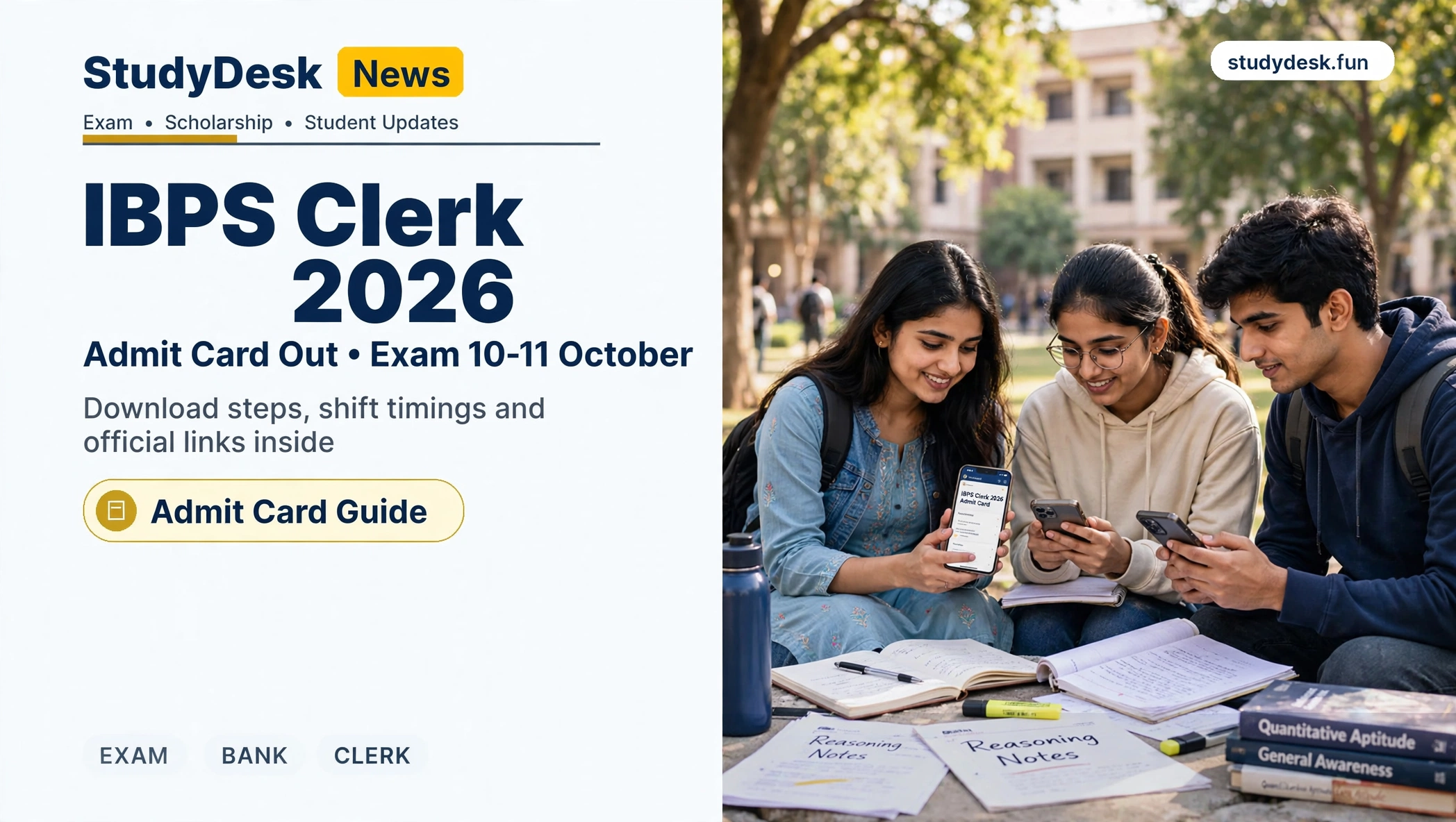
IBPS Clerk 2026 (CRP CSA-XVI): prelims call letter released, exam on 10-11 October 2026, mains on 27 December 2026. Full schedule and download guide.
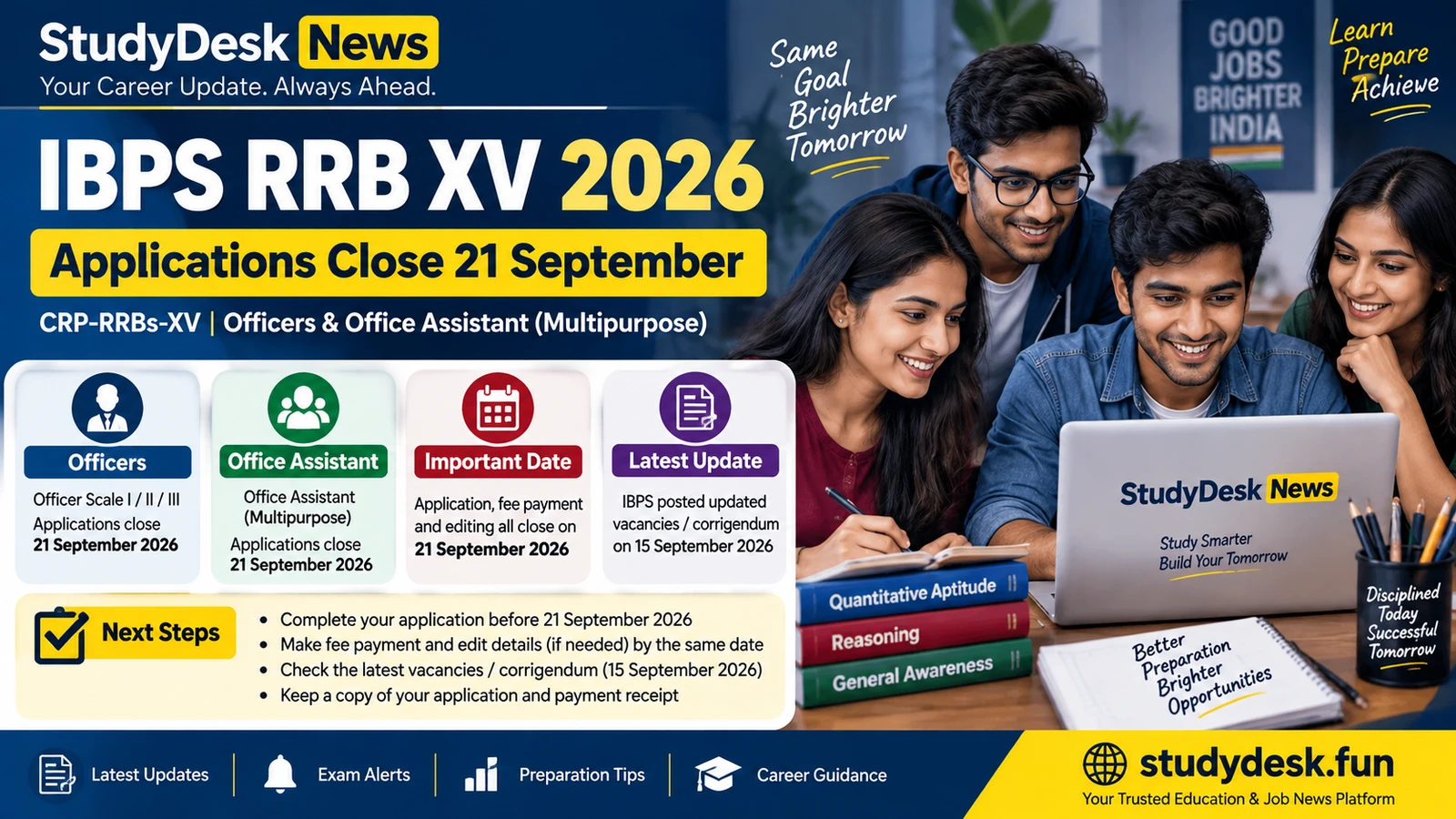
IBPS RRB XV 2026 application closure status, extended deadline, updated-vacancy status and next steps.
Complete guide to IBPS PO 2026 (CRP PO/MT-XVI): mains exam held, result expected in November 2026, interview and allotment schedule.