 StudyDesk

Start with the one document that is official
Almost everything circulating about SSC GD Constable 2027 is prediction wearing a uniform. So begin with what exists: the Staff Selection Commission's tentative examination calendar for 2026–27, released on 8 January 2026. In that calendar, the Constable (GD) examination for the 2027 cycle — covering the Central Armed Police Forces, NIA, SSF and Rifleman (GD) in Assam Rifles — is listed with an advertisement in September 2026, applications closing in October 2026, and the computer-based examination in January–March 2027.
Hold those three entries at arm's length, correctly. A calendar entry is SSC telling you its plan, not SSC opening a form. In the weeks since the calendar's September advertisement window, preparation portals have variously reported the notification as released, imminent, or expected within October — they do not agree, because the controlling artefact is the notification PDF on ssc.gov.in, and until you can open that PDF yourself, the honest status is: calendar-announced, notification awaited. This article is built to be useful in exactly that state: it separates the fixed scaffolding (eligibility pattern, selection stages, exam structure) from the numbers that only the notification can settle, so that when the PDF lands you can verify a page of facts in ten minutes instead of starting from zero.
The shape of the recruitment, as the previous cycle and calendar establish it
GD Constable recruits for the Border Security Force (BSF), Central Industrial Security Force (CISF), Central Reserve Police Force (CRPF), Indo-Tibetan Border Police (ITBP), Sashastra Seema Bal (SSB), Secretariat Security Force (SSF), Assam Rifles (Rifleman GD) and Sepoy in the Narcotics Control Bureau (NCB). The eligibility frame that successive GD notifications have used — and that the 2027 notification is expected to retain — is:
- Education: Matriculation (Class 10) from a recognised board.
- Age: 18 to 23 years as on 1 January 2027, with relaxations for reserved categories under government rules.
- Citizenship and other conditions: as the notification prescribes, including the physical standards below.
Treat the age cut-off date as the single most consequential line in the eventual notification: GD recruitments turn away large numbers of applicants on date-of-birth arithmetic alone, and the reckoning date is whatever the 2027 notification prints — expected to be 1 January 2027, confirmed only when printed.
The vacancy number: read it like an adult
Preparation portals currently project 25,000 or more vacancies for GD 2027, and one widely-circulated breakup simply repeats the previous cycle's force-wise distribution. The previous cycle did notify 25,487 vacancies (23,467 male and 2,020 female). None of that makes 25,000 a 2027 fact. The 2027 notification will carry its own force-wise, category-wise and state-wise tables, and those tables — not a projected total — determine your real competition, because GD allotment works against state/UT-wise vacancies. Until the PDF is out, plan your preparation, not your expectations, around the vacancy count. Any page stating an exact 2027 vacancy figure today, down to the last post, is recycling the previous cycle.
The five stages you are actually preparing for
- Computer Based Examination (CBE).The established GD pattern is 80 questions for 80 marks in 60 minutes, across four sections of 20 questions each — General Intelligence and Reasoning, General Knowledge and General Awareness, Elementary Mathematics, and English or Hindi — with negative marking of 0.25 per wrong answer, and the paper offered in English, Hindi and 13 regional languages. The notification confirms the pattern for 2027; historically it has been stable.
- Physical Efficiency Test (PET).Running standards by category and gender, applied to candidates shortlisted from the CBE at a multiple of vacancies.
- Physical Standard Test (PST).Height, chest (for male candidates) and weight measured against notified standards, with the relaxations the rules provide.
- Document verification, conducted alongside the physical stages.
- Detailed Medical Examination, with a review medical for those declared unfit who appeal within the rules.
The two lessons inside that list: the CBE is only the entry ticket — the physical stages remove more GD aspirants than any other part of the process — and the running standard cannot be built in the fortnight after the CBE result. Candidates who start physical preparation when the notification appears, rather than when the admit card does, are using the calendar the way it was meant to be used.
What to do in October, before the notification
- Complete your SSC One-Time Registration (OTR) on ssc.gov.in if you have not already. GD applications run through the OTR-based system; registering in a calm week beats registering on a crashing last day.
- Settle your documents: Class 10 certificate (it is both the education proof and the date-of-birth proof), category certificate in the prescribed format if you claim reservation, and identity documents with consistent name spellings across all of them.
- Measure yourself honestly against the physical standards from the previous notification — height and the run — and train to the standard with months in hand.
- Build the CBE base: the four sections reward breadth and speed; 80 questions in 60 minutes is a pace test as much as a knowledge test.
- Verify, then act. When the notification appears, check in order: the age reckoning date, the vacancy table for your state and category, the application window and fee, and any change to the exam pattern or physical standards. Only then apply — early in the window, not on its last evening.
One closing calibration: the GD 2026 cycle's result was published on 12 October 2026, which means a fresh cohort of selected candidates is moving through physical and medical stages right now while the 2027 cycle waits for its notification. That overlap is normal for SSC's calendar. What is not normal — and should make you suspicious of any source — is certainty about 2027 numbers that SSC itself has not yet printed.
Sources & verification
Frequently asked questions
What does the official SSC calendar say for GD Constable 2027?
In SSC's tentative calendar for 2026–27, released on 8 January 2026, GD Constable 2027 is listed with an advertisement in September 2026, applications closing in October 2026, and the computer-based examination in January–March 2027. The honest status in this article is calendar-announced, notification awaited.
What are the expected education and age requirements?
The eligibility frame successive GD notifications have used, and that 2027 is expected to retain, is Matriculation (Class 10) from a recognised board, and age 18 to 23 years as on 1 January 2027, with relaxations for reserved categories under government rules. The reckoning date is confirmed only when the notification prints it.
How many vacancies will GD Constable 2027 have?
No 2027 total is confirmed in this article. Preparation portals project 25,000 or more, and the previous cycle notified 25,487 vacancies (23,467 male and 2,020 female), but that previous figure is historical, not a 2027 promise.
What is the CBE pattern described in this article?
The established GD pattern is 80 questions for 80 marks in 60 minutes, across four sections of 20 questions each — General Intelligence and Reasoning, General Knowledge and General Awareness, Elementary Mathematics, and English or Hindi — with negative marking of 0.25 per wrong answer.
What are the selection stages after the CBE?
The five stages are the Computer Based Examination, Physical Efficiency Test, Physical Standard Test, document verification conducted alongside the physical stages, and the Detailed Medical Examination, with a review medical for those declared unfit who appeal within the rules.

NITTT 2027 tentative schedule from the official NTA examination calendar.
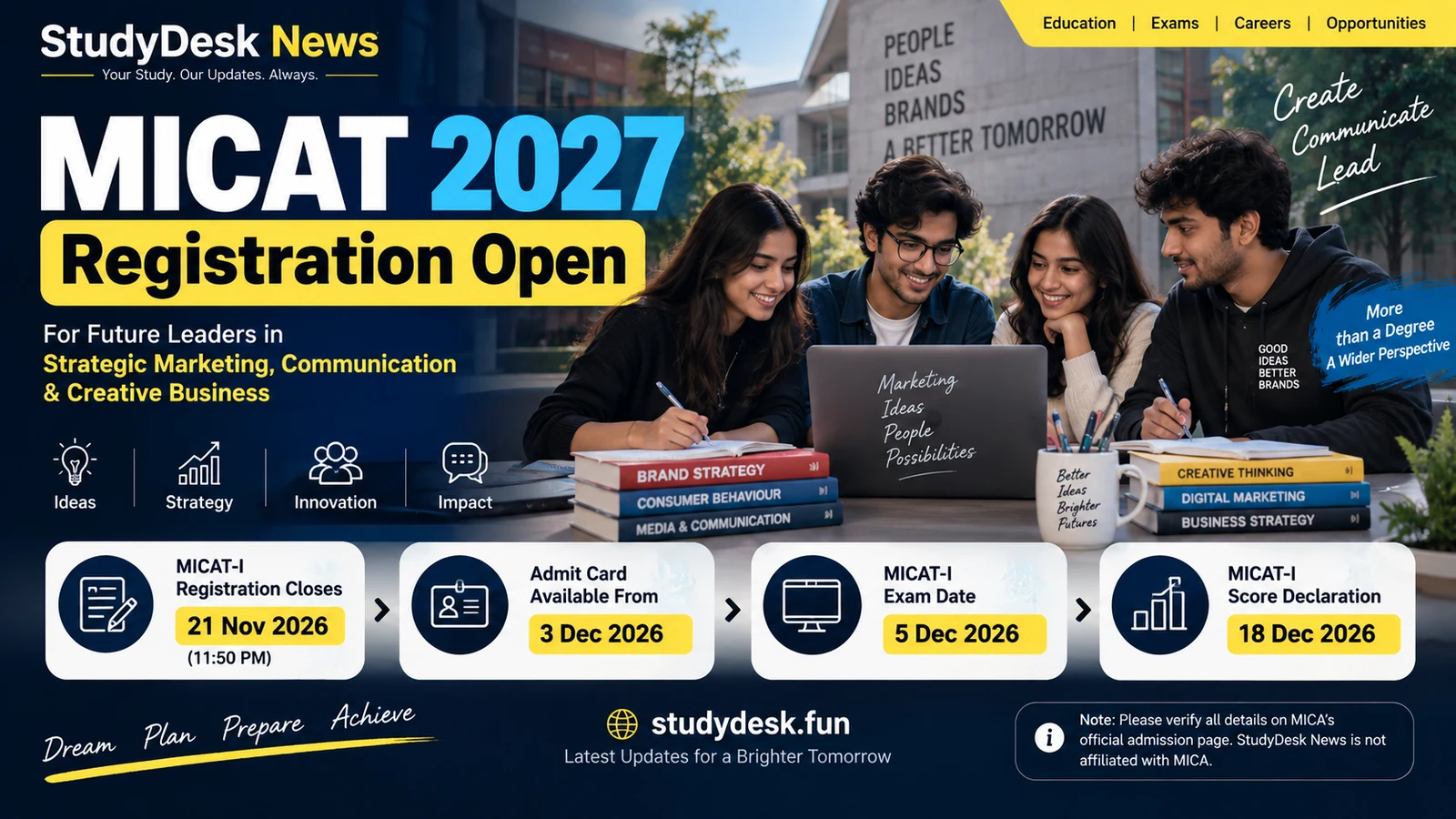
MICAT 2027 registration dates, MICAT-I exam schedule, official MICA admissions source and next steps.

SSC Junior Engineer 2026 application closure, disciplines and tentative exam-period update.
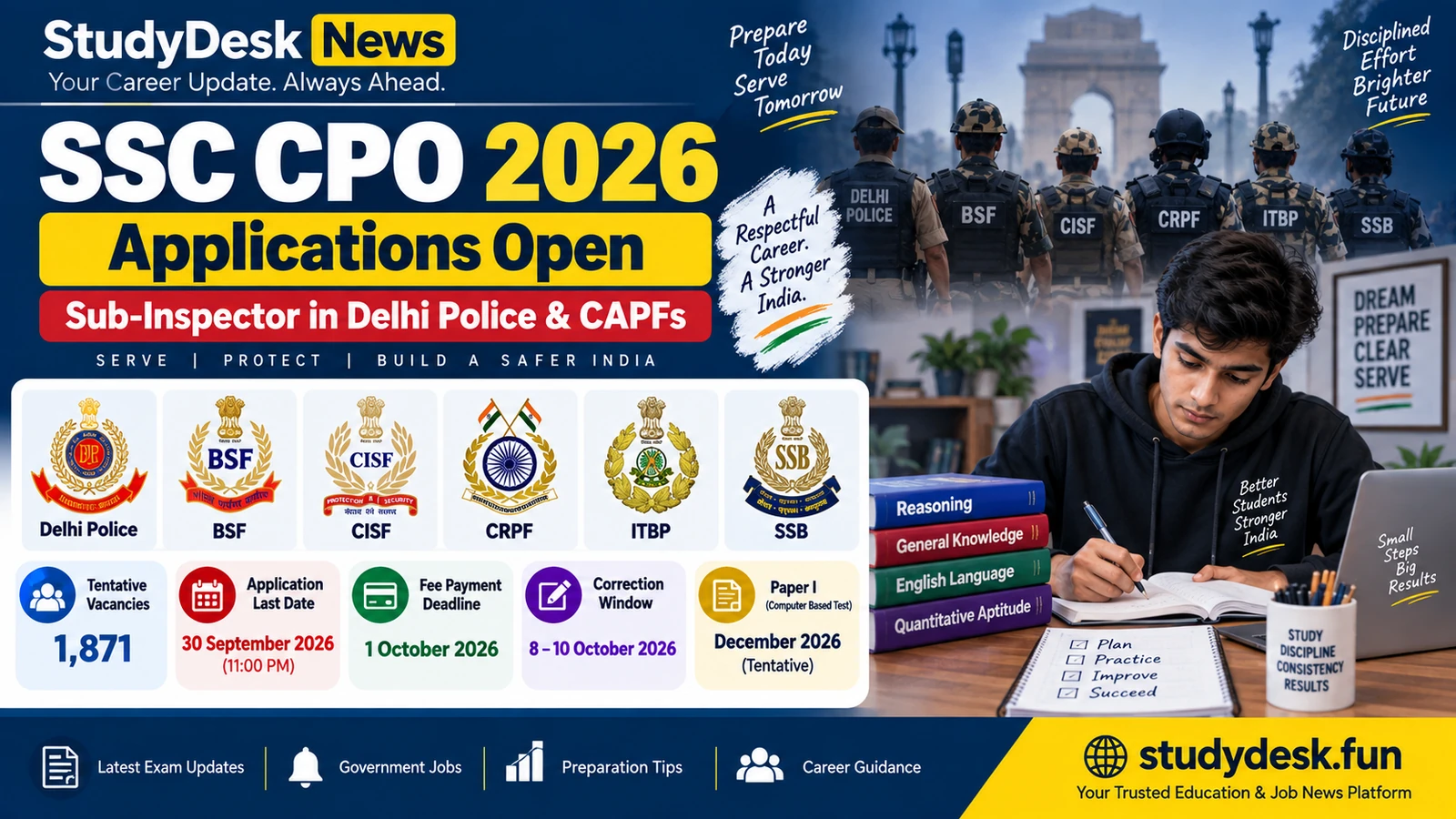
SSC CPO 2026 application closure, correction window and Paper-I schedule update.
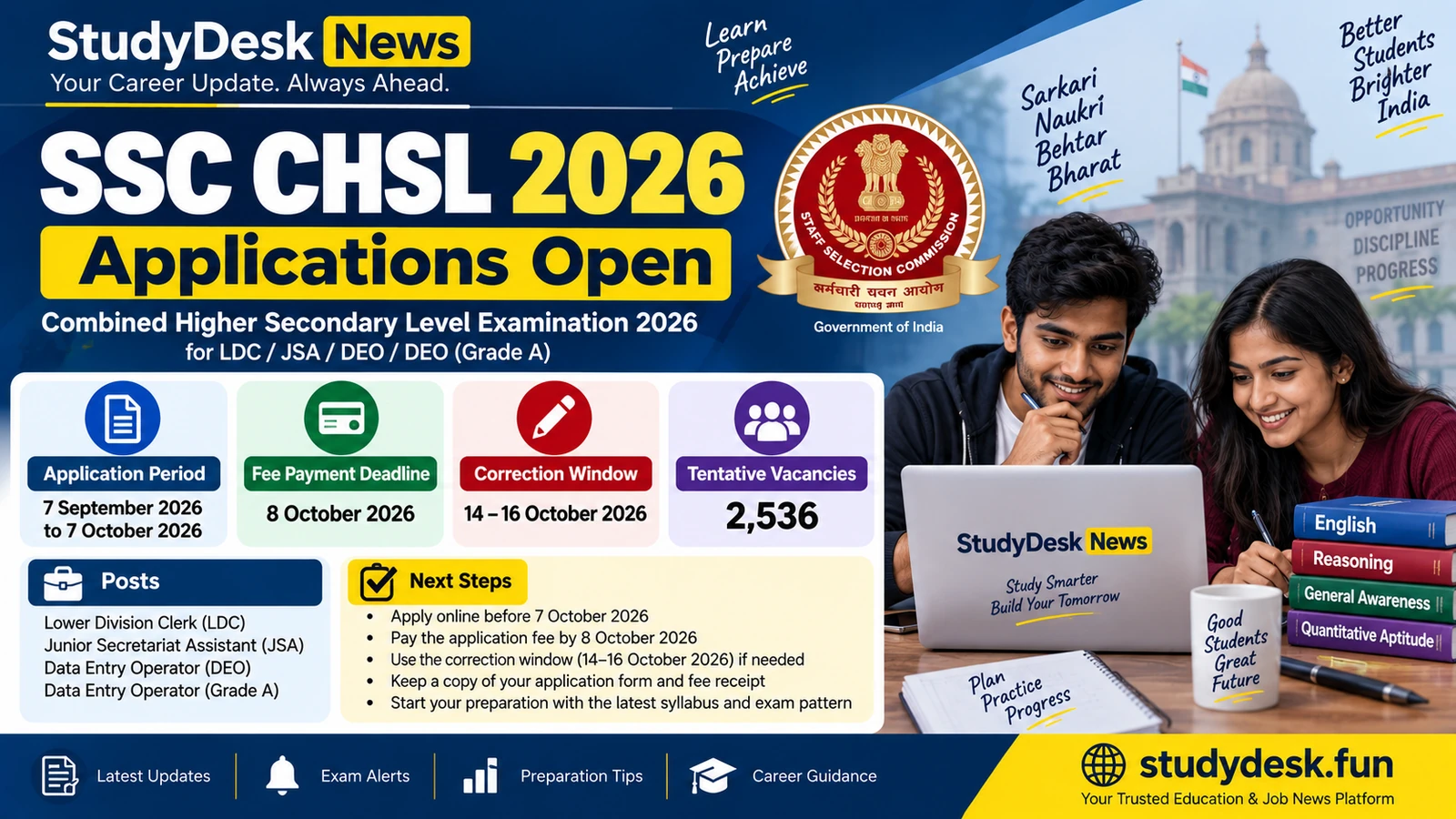
SSC CHSL 2026 application closure, correction window, tentative vacancies and Tier-I exam schedule update.